Power banks in carry-on bags: read the Wh label before you fly
Read a power bank's watt-hour rating, understand FAA carry-on requirements and check airline limits before packing a portable charger for your flight.
Content Writer Specialist for Rumbía’s English blog, focused on practical travel guidance, airline policy explainers, baggage and ticketing questions, and reader-friendly destination planning.
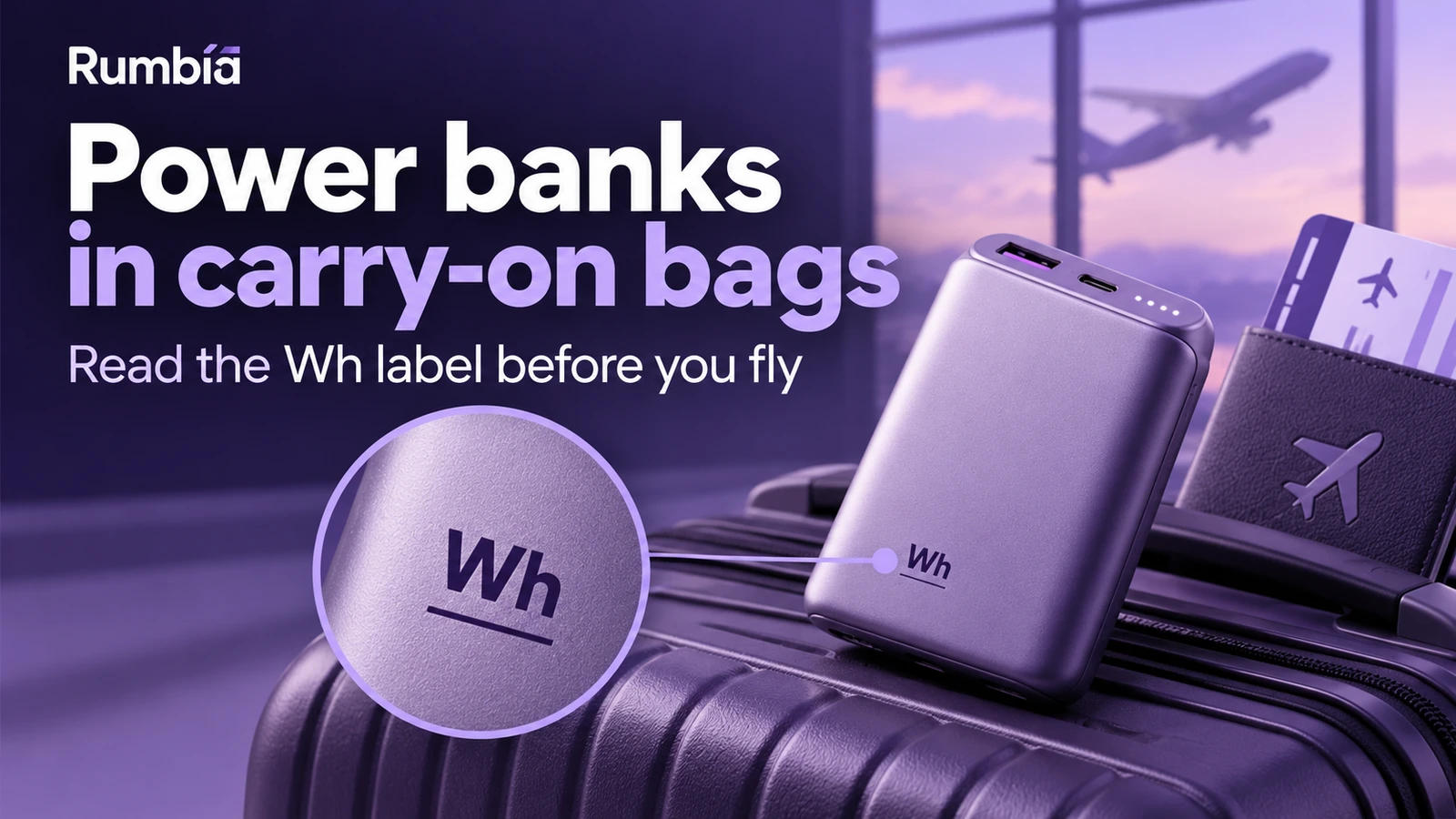
Before packing a power bank, find its watt-hour rating, check the operating airline's current power-bank limits, and keep it in the cabin. A large mAh number on the packaging is not enough to establish airline acceptance. Also plan to remove the charger if your cabin bag is taken for gate checking.
This guide uses current U.S. FAA guidance as the regulatory reference. Airlines and other countries can impose stricter limits, including how many power banks you may carry and whether you may use or recharge them in flight.
Read the battery label, not just the marketing name
Look for “Wh” on the unit or its manufacturer specifications. Photograph the readable label for your own preparation, but keep the actual unit's markings intact. If the rating or model is unclear, obtain the manufacturer's specification and ask the airline what evidence it requires before travel.
Where calculation is necessary, the FAA battery guidance explains that watt-hours equal volts multiplied by amp-hours. Convert milliamp-hours to amp-hours by dividing by 1,000. Use the battery's correct rated values, rather than selecting a convenient output-port voltage.
For a hypothetical label stating 10,000mAh at 3.7V, the calculation is 10 × 3.7 = 37Wh. That arithmetic explains the energy rating; it does not independently establish that the item is approved, undamaged or accepted by every airline. If the manufacturer already states Wh, do not replace that rating with a calculation based on an unrelated charging mode.
Use the FAA baseline without treating it as every airline's policy
The FAA's U.S. passenger guidance uses 100Wh as the normal lithium-ion battery limit. Its larger-spare-battery category above that level, up to 160Wh, requires airline approval and has a two-spare limit. Batteries above 160Wh fall outside the ordinary passenger allowance. Do not read this as an instruction to arrive with a larger power bank and seek approval at boarding.
The same official guidance explicitly warns that carriers may set stricter quantity and Wh limits. Check the operating airline's power-bank policy for every flight, including partner-operated segments. Acceptance on an earlier trip is not confirmation for a different carrier or a revised policy.
Record the model, Wh rating, number of units and each operator's relevant restriction. If approval is needed and available under that operator's rules, obtain it through the stated process before travelling. If the operator excludes the item, the broader baseline does not override that exclusion.
Pack for the cabin and for a possible gate check
The FAA PackSafe lithium-battery guidance requires spare lithium batteries, including power banks, in carry-on baggage and protected against short circuit and damage. Put the unit where you can remove it without emptying the whole bag. Protect it from contact with loose metal objects and from being crushed.
If staff take your carry-on for the hold, remove the power bank before handing over the bag and retain it in the cabin. A bag's original status as carry-on does not make its contents suitable for checked transport after a gate-check decision.
For the rest of your bag allowance, see our Delta baggage guide when travelling with that airline. Bag size and piece allowance are separate from whether a battery can travel in the hold. Likewise, the TSA liquids packing guide covers another screening category; a power bank is assessed under battery rules rather than the liquids bag allowance.
Carrying it and using it are different permissions
Read the airline's rules about charging devices, charging the power bank itself and where the unit must be kept during flight. Follow crew instructions. A compliant Wh label does not by itself establish permission to use the unit at your seat.
Do not travel with a swollen, damaged or recalled battery that poses a heat or spark hazard. If a unit becomes hot, expands, smokes or burns on board, notify the crew immediately. Do not hide the problem in a bag or attempt an improvised repair during the flight.
Frequently asked questions
Does 20,000mAh tell me whether a power bank is allowed?
Not by itself. Find the Wh rating and manufacturer details, then check the airline's limits. A calculation needs the correct battery voltage as well as capacity.
Can I leave it in a cabin bag that is gate checked?
No. Remove the power bank and keep it in the cabin before the bag is handed over for checked transport.
Does being under 100Wh mean unlimited units on every airline?
No. Carriers can impose stricter quantity and capacity limits. Check the current policy for each operating airline.
Can I use it if the airline lets me carry it?
Check separately. The operator may restrict in-flight use, recharging or storage even when carriage is permitted.
About William Smith
Content Writer Specialist for Rumbía’s English blog, focused on practical travel guidance, airline policy explainers, baggage and ticketing questions, and reader-friendly destination planning.
LinkedIn profile
Interested in travel updates?
Leave your email if you would like to hear from Rumbía about new guides and articles.
Your request is emailed to Rumbía. This form does not start an automatic newsletter subscription.