Connecting hotel rooms versus adjoining rooms: ask the exact question
Ask whether rooms have an internal connecting door, distinguish a request from a confirmed booking and verify the arrangement for your travel dates.
Rumbía Editorial Team
Rumbía publishes practical travel guides based on official sources and clearly scoped booking conditions.
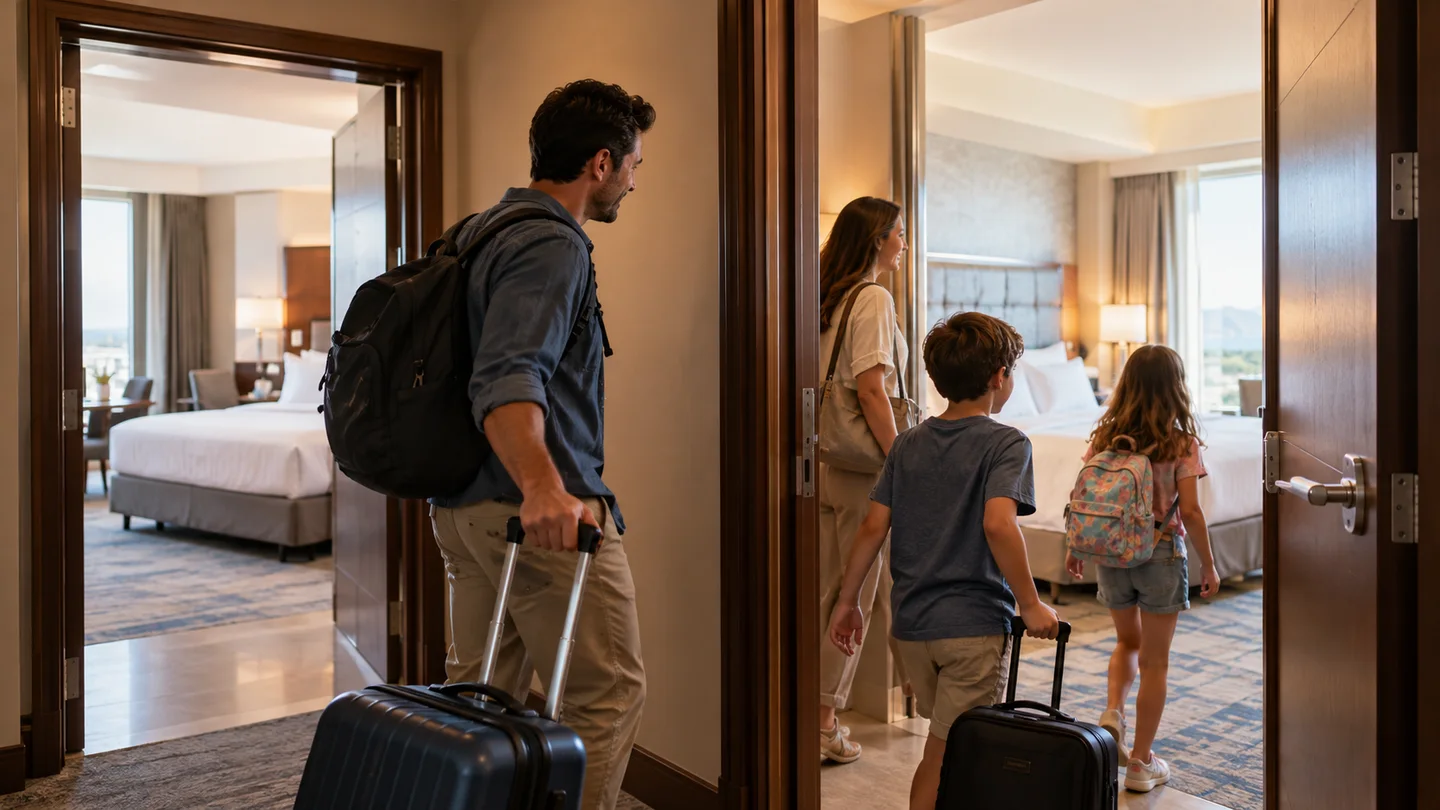
If you need to walk directly between two hotel rooms without using the public corridor, ask for rooms with an internal connecting door. Do not rely on the word adjoining alone. A property's room labels, a booking site's description and a guest's understanding may not match.
Two rooms being close together can solve a location preference. A connecting door solves a different need: moving between the spaces privately. Before comparing prices, describe which arrangement your group actually requires and establish whether it is a confirmed booking feature or a request considered later.
Start with the physical arrangement
Use these descriptions when you contact a hotel:
- Internal connection: a door directly between the booked rooms, usable by the occupants during the stay.
- Next door: rooms beside one another, which may still require entering the corridor.
- Nearby: a location preference that could mean the same floor or a short walk, depending on what the property means.
- One shared accommodation: a suite or multi-bedroom unit, whose layout should be checked separately from a pair of standard rooms.
These descriptions are questions to resolve, not a universal hotel dictionary. Ask the property to confirm the door and layout in plain language. A floor plan can help, but make sure it represents the room combination you are reserving rather than an example elsewhere in the building.
Choose according to the reason you need two rooms
A family needs direct access between sleeping areas
Explain the number and ages of the guests, required bed configuration and that you need an internal door. Check the property's occupancy and supervision rules for your actual arrangement. Do not assume that two confirmations under the same surname establish either a connecting pair or permission for the intended sleeping arrangements.
Hypothetical example: two adults and children need two bedrooms, with direct access for an adult during the night. A note saying rooms near each other leaves the essential issue unresolved. Ask whether the quoted combination includes a connecting door and whether the occupancy arrangement is accepted.
Friends want separate rooms near one another
If a direct door is only a preference, decide whether adjacent or same-floor rooms would also work. That gives you a clearer basis for comparing a confirmed connecting product with a less expensive alternative carrying only a location request. Keep the budget decision separate from any feature your group cannot do without.
One guest needs an accessible room
Specify the required accessibility features as well as the connection. A connecting pair does not automatically meet mobility, bathroom or other access needs. Ask whether the particular accessible room can form part of the proposed pair, rather than accepting two unrelated assurances about accessibility and connecting rooms.
A request and a confirmed product are different
Look for how the arrangement appears in the actual booking. A special-requests box may communicate a preference without confirming it. A room product explicitly sold with the connection is a more specific arrangement, but you still need to read its conditions and confirmation.
Hilton's Confirmed Connecting Rooms FAQ provides one concrete example. At participating hotels, the feature is booked through Hilton's website or app; the confirmation identifies the connecting rooms. Hilton also distinguishes this from an ordinary request that remains subject to availability at check-in.
That is a defined Hilton booking feature, not evidence that every hotel brand, travel agency or rate offers the same commitment. When another seller uses a similar label, ask what its confirmation actually includes.
Read the confirmation as if you had to explain it at reception
Check the property, dates, room count, bed types, guest details and the specific connection. Save any written answer that identifies your reservation. A general reply saying “our hotel has connecting rooms” establishes that they exist, not that they are reserved for you.
Also clarify whether the quoted amount covers both rooms and which conditions apply to each. Do not compare the price of one room with the total for a pair. If you are booking separately, ask how the property links the reservations and whether both must cover the same dates to meet your needs.
Our hotel booking and guest-name guide can help if different people are paying for or occupying the rooms. Get the occupants attached to the right bookings rather than assuming one purchaser's name resolves every check-in question.
A useful message to send before you pay
We need two rooms for [dates] for [guest numbers and ages]. We require a door directly between the rooms so we do not need to use the corridor. The required bed types are [details], and our accessibility requirements are [details, if any]. Does the quoted product confirm this exact arrangement, or is it a request subject to availability? Please identify both rooms and the connection in the booking confirmation and explain our options if the arrangement cannot be provided.
Adapt the message to your group. Do not treat sending it as confirmation: keep the property's actual response. If you booked through an intermediary, ask whether a change must be made by that seller and whether the hotel's reply refers to the reservations you bought.
Recheck the pair when plans change
Changing dates, bed types or one room can affect the arrangement. Before cancelling or modifying anything, ask how to preserve the connection and compare the cancellation conditions for the whole booking. Do not cancel a usable reservation until you understand the availability and terms of the replacement.
At check-in, confirm the assigned rooms and connection before distributing luggage and keys. If the setup differs, show the specific confirmation and explain the essential need. Ask about workable alternatives and their terms without assuming a particular refund or upgrade is guaranteed.
Room layout is only one part of choosing a property. For a Paris stay, our Paris accommodation-area guide helps you consider the location alongside the room arrangement.
Frequently asked questions
Do adjoining rooms always have an internal door?
Do not assume so. Ask whether the booked rooms connect directly and whether your group can use that door. Plain language avoids relying on an ambiguous label.
Does booking two rooms together confirm that they connect?
No. Check whether the connection itself is part of the confirmed product. Room count and physical connection are separate details.
Can I request connecting rooms after booking?
You can ask, but establish whether it remains a preference or becomes a confirmed feature. Availability and the seller's process matter.
Is an accessible connecting pair the same as any connecting pair?
No. Confirm the required accessibility features in the specific rooms as well as the internal door.
Official Hilton feature information reviewed October 15, 2026. Confirm the actual property, product and guest arrangement before booking.
About Rumbía Editorial Team
Rumbía publishes practical travel guides based on official sources and clearly scoped booking conditions.



Interested in travel updates?
Leave your email if you would like to hear from Rumbía about new guides and articles.
Your request is emailed to Rumbía. This form does not start an automatic newsletter subscription.